
Save Our Pigs!
The pork lobby is one farm bill away from gutting our strongest farm animal welfare laws

Last Thursday, the US House of Representatives passed a farm bill containing the “Save Our Bacon” Act. The Act’s stated aim is narrow: to wipe out California and Massachusetts’ bans on the sale of pork from pigs confined in gestation crates.
Its reach is much wider. The Act would stop any state or locality from regulating the sale of meat based on how it’s produced in another state. This would likely invalidate state and local bans on foie gras, crated veal, and more.
It would also halt future legislative progress. Congress hasn't passed a farm animal welfare law in decades. State laws are where reforms actually happen. The SOB Act would gut them by mandating they contain a giant loophole for out-of-state imports.
The Act has two notable exemptions. One is welcome: state bans on the sale of caged eggs aren’t covered. The other is telling: state bans on cultivated meat aren’t covered either. The Act applies only to meat from “any domestic animal raised for the purpose of … slaughter for human consumption,” plus dairy cows.
The bill now heads to the Senate. Advocates need to win two fights: keep the SOB Act out of the Senate’s version, and keep it out of the reconciled bill that merges the House and Senate versions. Both will be challenging.
So what’s going on, and what can we do about it?
Crate fight
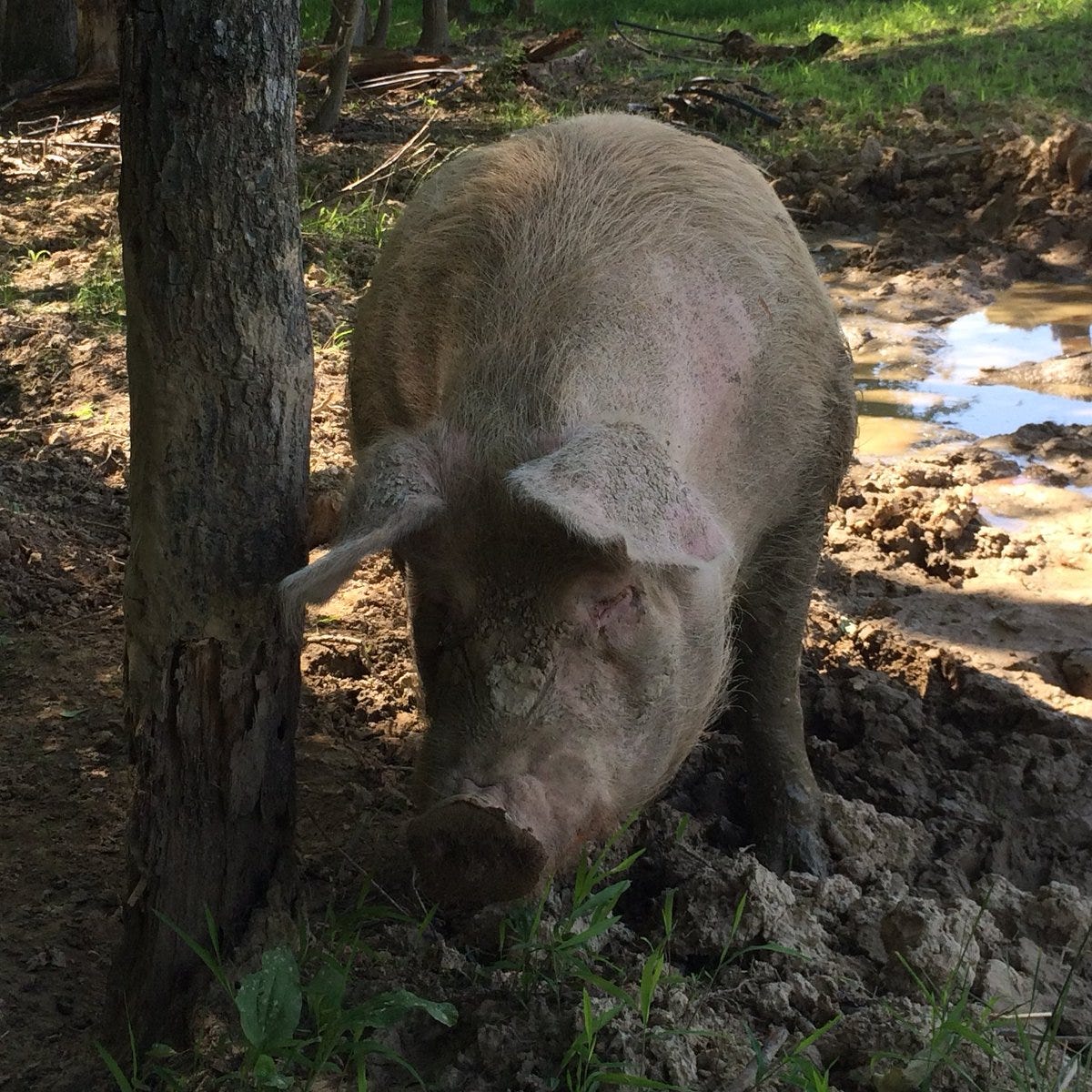
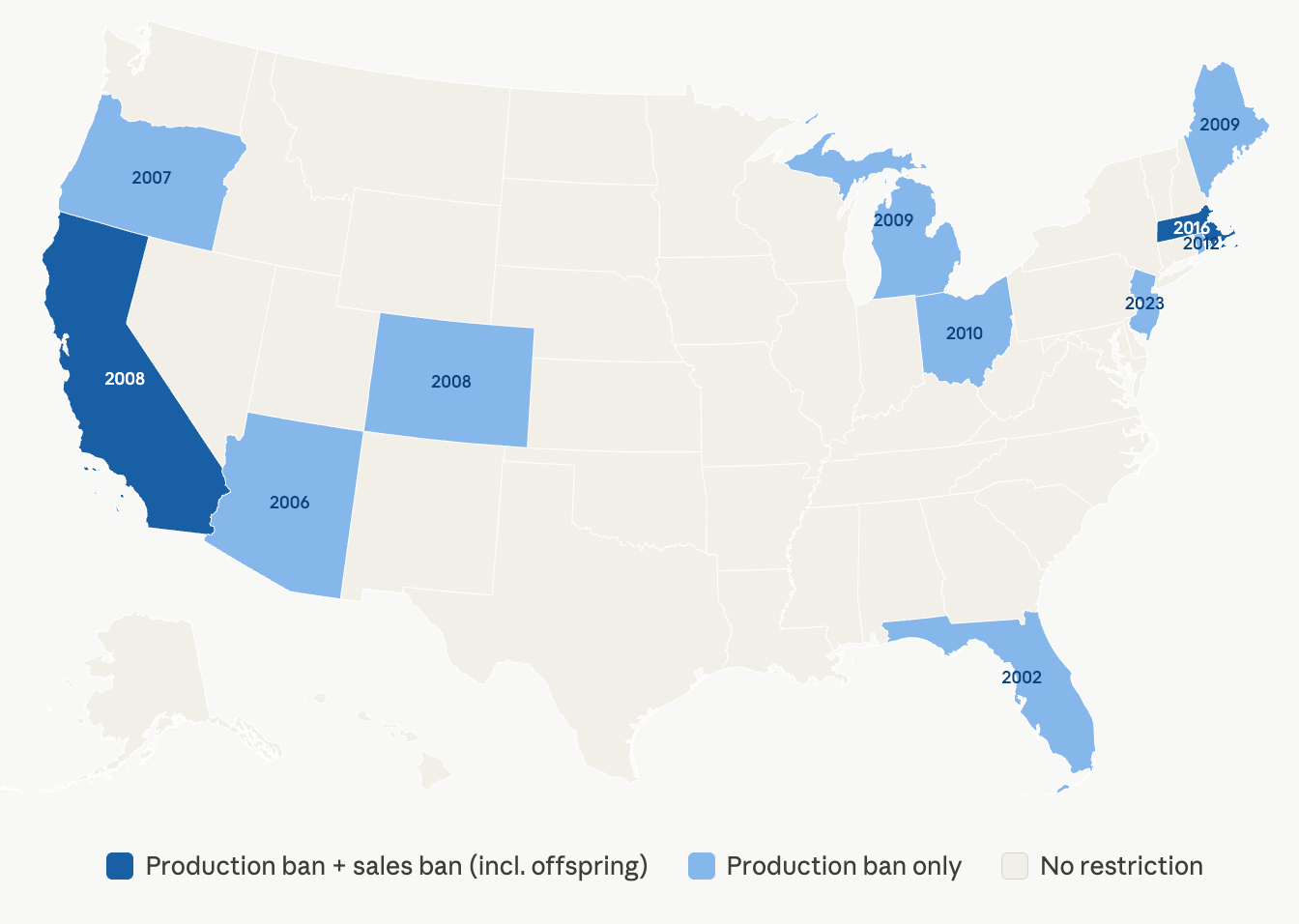
The battle began a quarter century ago, when advocates won a 2002 Florida ballot measure to ban gestation crates. Over the next decade, advocates won similar bans through ballot measures, or the threat of them, in eight more states, from California to Maine.
These bans shared a limitation: they banned crates within the state, but not the sale of pork from pigs crated elsewhere. Most states that banned the crates didn’t produce much pork, so most pork sold in these states continued to come from crated pigs and their offspring.
That changed in 2016 and 2018, with Massachusetts’ Question 3 and California’s Prop 12, which advocates won with 78% and 63% of the vote respectively. Both banned the sale of most pork from crated sows and their offspring, regardless of where it was produced.
Both laws also defined ‘crate-free’ more rigorously than the industry. Producers like Smithfield, the country’s largest, define “crate-free” to allow crating sows for 25-40% of their pregnancies. The new laws required sows be crate-free for their full pregnancies and mandated they get more space than is standard in group housing.
That irked the pork industry. It lobbied Congress to overturn the laws. It got the polarizing Rep. Steve King (R-IA) to slip language doing so into the 2018 farm bill — must-pass legislation that Congress reauthorizes every five years. It failed.
It also sued California and Massachusetts — seven times. One case reached the US Supreme Court, which in 2023 upheld Prop 12 in a 5–4 ruling that scrambled conservative–liberal lines. (My writeup here.) Unchastened, the industry started lobbying Congress again.
That SOB
This time the pork industry found a stronger champion: House Agriculture Committee Chair Glenn Thompson (R-PA). He wrote the SOB Act into the farm bill and pushed it through committee to a full House vote.
Advocates mounted a major play to amend it out. They lined up a remarkable bipartisan list of sponsors, from MAGA Republicans like Rep. Anna Paulina Luna (R-FL) to liberal Democrats like Rep. Nancy Pelosi (D-CA). If the amendment had gotten a vote, we almost certainly would have won — advocates had already gotten almost half the House to publicly oppose the SOB Act.
But it never got a vote. The House Rules Committee, under heavy lobbying from Rep. Thompson, declined to allow a vote on this amendment — even as it allowed votes on 57 other amendments to the farm bill, on topics ranging from composting to greyhound racing.
Republican leadership then rushed the bill to the floor. That put our Republican allies in a tough spot: to oppose the SOB Act, they would have had to buck their own leadership and vote down the entire farm bill over a single provision. Most didn’t. Only three Republicans voted no, while 14 Democrats voted yes.
The bill now heads to the Senate. If the Senate passes its own version of the farm bill — and congressional dysfunction could yet stop it from doing so — the two bills will go to a conference committee or “pre-conference” meeting to be reconciled. The reconciled bill will then go to President Trump for his signature.
The current crate of play
The immediate priority is to keep the SOB Act out of the Senate’s version of the farm bill. That will largely be decided by Senate Agriculture Committee Chair John Boozman (R-AR) and Ranking Member Amy Klobuchar (D-MN).
Advocates have made real progress here. Sen. Klobuchar has privately told people that committee Democrats will oppose the measure. Sen. Boozman told the San Francisco Chronicle on Thursday that, although he supports nullifying Prop 12, he’s not sure the SOB Act will make it into the Senate bill, because of its unpopularity with Democrats.
That's a good start. But we need to keep the pressure on. Sen. Klobuchar has pointedly refused to publicly oppose the SOB Act. Asked about it this week, her office would only say: “We look forward to working with Senate Republicans on a bipartisan Farm Bill that can be successful on the Senate floor.” Not the words of someone fighting on this issue. That may have something to do with her current run for Governor of Minnesota, the second-largest pork producing state.
Sen. Boozman, meanwhile, floated a compromise last week: the farm bill could ban any new state laws like Prop 12, but grandfather in the existing California and Massachusetts ones. That beats wiping out the existing laws. But it would still halt most future state legislative progress on farm animal welfare in the US.
And that’s just the Senate committee. The bigger fight comes next, when the House and Senate bills get reconciled. The main players there will be Senators Boozman and Klobuchar, plus Representatives Thompson and Angie Craig (D-MN), the ranking member on House Agriculture.
I’m much more worried about this stage. Asked about SOB, Rep. Thompson said on Thursday that he’ll “fight for that provision” in conference. It’s not clear who will fight back. Not Sen. Boozman, nor likely Sen. Klobuchar right now. That leaves everything on Rep. Craig, who has spoken out against the SOB Act, but who will also be the most junior voice in the negotiations.
Make the call
The top priority is to get Sen. Klobuchar to make this a redline issue for Democrats — to say they won’t support any farm bill that includes the SOB Act. She has so far refused. Moving her requires mobilizing her constituents and getting other Democratic senators to tell her how much this matters to them.
We also need to keep pressure on sympathetic Republicans. Rep. Thompson is a lost cause. But continued Republican opposition could persuade Sen. Boozman that keeping the Act in the farm bill isn’t worth the political cost.
We have plenty of bipartisan support to draw on. On X, sentiment has been roughly 50:1 in our favor — with prominent conservatives (Laura Ingraham, Tomi Lahren, Mike Cernovich, Glenn Greenwald) and liberals (Nicholas Kristof, Steven Pinker) alike speaking out against it.
We need to funnel that support into political pressure. American readers can call the Senate switchboard at (202) 224-3121 and ask to be connected to their senators’ offices. Tell them to oppose any farm bill that includes the SOB Act. If you’re feeling motivated, call their local constituent offices too — or, better yet, drop by in person. If you donate politically, your voice carries added weight.
We need to win this fight. Losing would condemn millions of pigs to a lifetime in crates — and stop states from meaningfully regulating farm animal welfare in the future. Winning would spare those pigs, protect states’ ability to regulate, and signal to the pork industry that the crates have no future. Let’s make sure of it.
I hate phone calls but this is important enough that I actually called both my senators (was only able to reach and leave a message for one)! Sent emails as well. Thanks for giving me the prod to do this
I live in Pennsylvania, a Commonwealth, yet when I tried to email Rep Thompson I received the following automated response, Outside of District and was unable to submit my comment. This is a problem with our alleged democracy.