
Make Cruelty Unprofitable Again
How to crack the cruelty collective action problem

Last month, eight large UK fast food chains — including KFC, Nando’s, and Burger King — scrapped their pledges to adopt higher-welfare chicken standards under the Better Chicken Commitment. They blamed supply shortages, demand shocks, even the climate impact of the promised reforms.
But suppose the reforms had been profitable. Does anyone really think these chains would have found those obstacles insurmountable? The reasons were rationalizations, not motivations.
Most cruelty to farm animals today persists for one simple reason: it is profitable. That logic explains far more than the press releases do. The familiar arguments about why cages are “necessary,” mutilations are “for the animals’ benefit,” and slower-growing breeds are “impractical” speak more to the creativity of PR firms than the realities of reform.
It wasn’t always this way — and it need not always be. The agricultural industrial revolution trapped farming in a cruelty collective action problem. How can we solve it?
When cruelty didn’t pay
For most of human history, extreme cruelty toward farm animals simply wasn’t profitable. Farmers only owned a few animals, each of whom was valuable. Without vaccines and antibiotics to keep them alive in poor conditions, good treatment was good business.
Much of the ancient wisdom on animal care reflects this logic. The Old Testament extended the Sabbath to working animals, so that “your ox and your donkey may have rest.” The Roman writer Columella warned against cruelty, arguing that “excessive severity causes both men and cattle to become useless.” The Chinese agronomist Jia Sixie advised farmers: “In the heat of summer, reduce the ox’s labor; in severe cold, protect them from exposure.”
This didn’t mean animals were safe from harm. In the absence of a profit motive, humans found plenty of other motives for cruelty: sport, superstition, war, gambling, fashion, tradition, or just plain fun.
The Industrial Revolution initially helped. Machines replaced entire categories of animal abuse, from working horses to coal ponies. And rising prosperity created a new middle class that demanded humane reforms. The list of acceptable motivations for cruelty shrank dramatically. In the 16th century, Queen Elizabeth I hosted bear-baiting spectacles for visiting diplomats; by the 21st, Queen Elizabeth II couldn’t get away with wearing a fur coat.
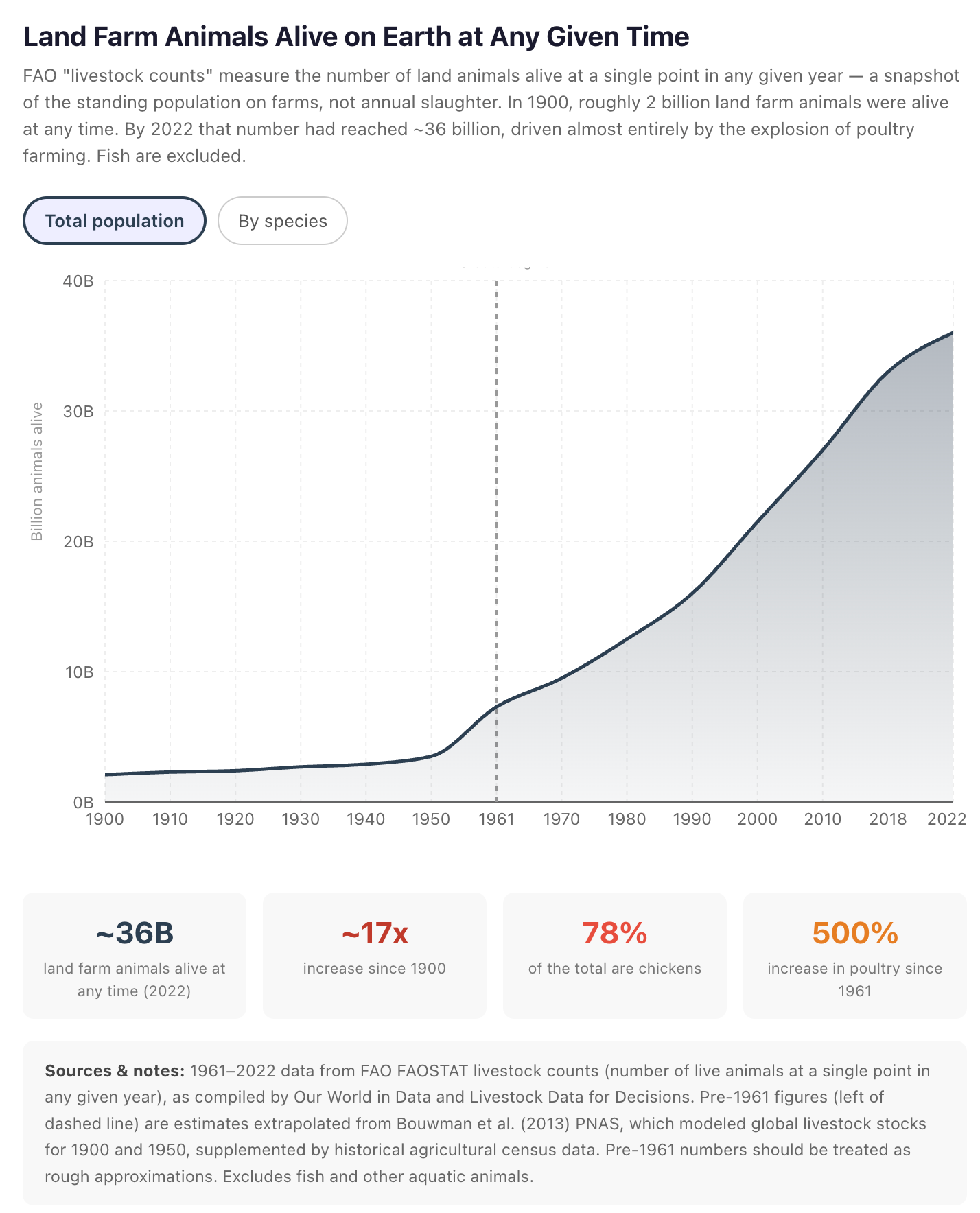
But this humane progress was quickly undone by further technological progress. New antibiotics, vaccines, and synthesized vitamins let farmers keep vast numbers of animals alive in wretched conditions, severing the historic link between good treatment and productivity. Rising prosperity spiked demand for meat, spurring the growth of factory farms from the 1950s on.
The result is our confused reality today. Opposition to cruelty to animals is likely more widespread than it has ever been. And so is cruelty to animals.
The cruelty collective action problem
This confusion is also an opportunity. No one really likes factory farming. Consumers overwhelmingly disapprove of its most common practices. Small farmers resent that it has bankrupted so many of them. Even factory farmers often hate that it’s reduced them to indebted contractors. Animals presumably like it least of all.
It’s easy to imagine a better system. Consumers would get products that reflect their values. Farmers would get better pay and more meaningful work — most would rather practice animal husbandry than dead animal removal. Animals would live vastly better lives.
The problem isn’t imagination — it’s coordination. If one farmer unilaterally raises their standards, competitors will undercut them. But as the economist Yew-Kwang Ng has pointed out, if all producers raise standards together, profits need not fall. The industry will simply settle at a new equilibrium of slightly higher costs and prices.
Would consumers be worse off? Not necessarily. It’s true that shoppers don’t always choose pricier higher-welfare products at the supermarket. But when given the chance to vote for higher welfare standards — as in California’s Prop 12 — they almost always say yes. There’s evidence that this is because consumers treat animal welfare as a public good: they’re willing to pay for it collectively, but reluctant to shoulder the cost alone while others free-ride.
So we’re left with a collective action problem. A higher-welfare system could leave most parties better off, yet no individual actor has the incentive to move first. How to solve it?
Stop the free rider
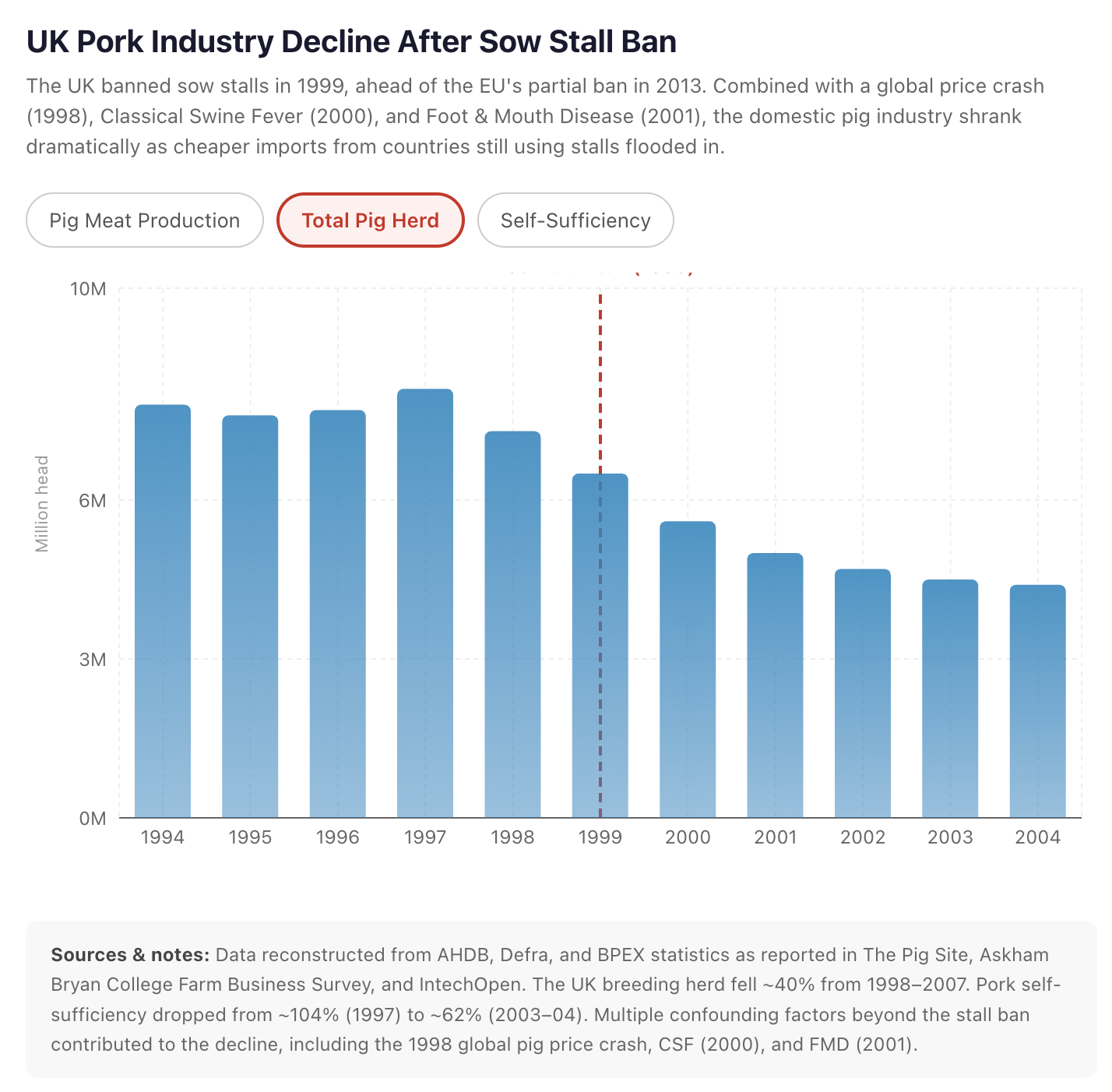
Collective action problems have a classic villain: the free rider who refuses to reform while everyone else does, then undercuts them on price. The best fix is regulation — you can’t defect from a properly-enforced law. But domestic producers rightly object that regulations rarely apply to imports, leaving them exposed to cheap low-welfare imports. After the UK and New Zealand banned gestation crates, both watched their pork industries shrink as cheaper imports from crated pigs flooded in.
That makes it essential that new welfare standards apply to imports too. Despite objections from free traders, this is feasible. The EU already applies its humane slaughter standards to imported meat, and the WTO’s appellate body has ruled that animal welfare trade restrictions can be justified on moral grounds. The EU is now considering extending its long-promised cage ban to imported eggs — it’s critical that it does so.
Until such legislation is in place, industry-wide agreements offer another route. Advocates recently secured one from the Norwegian poultry industry, which collectively agreed to adopt higher-welfare breeds and phase out the killing of male chicks. When everyone moves at once, no one is disadvantaged.
Corporate campaigns offer yet another lever. When supermarkets and fast food chains set welfare standards, those standards apply equally to all suppliers, including importers. But these companies face their own collective action problem: no one wants to move first and be undercut by lower-welfare rivals.
Advocates can break this deadlock by targeting corporate free riders. That’s the logic behind the recently victorious campaign against Ahold Delhaize, the fourth-largest US supermarket owner. Ahold had backtracked on its cage-free pledge, undercutting rivals like Costco who had made good on theirs. Now that advocates have secured concrete implementation plans from Ahold, it cracks open the logjam for its competitors to follow suit.
Make the right option cheaper
Advocates have raised the cost of cruelty through these campaigns, and will continue to do so. They’re also increasingly eroding cruelty’s advantage from the other direction: by making humane alternatives cheaper.
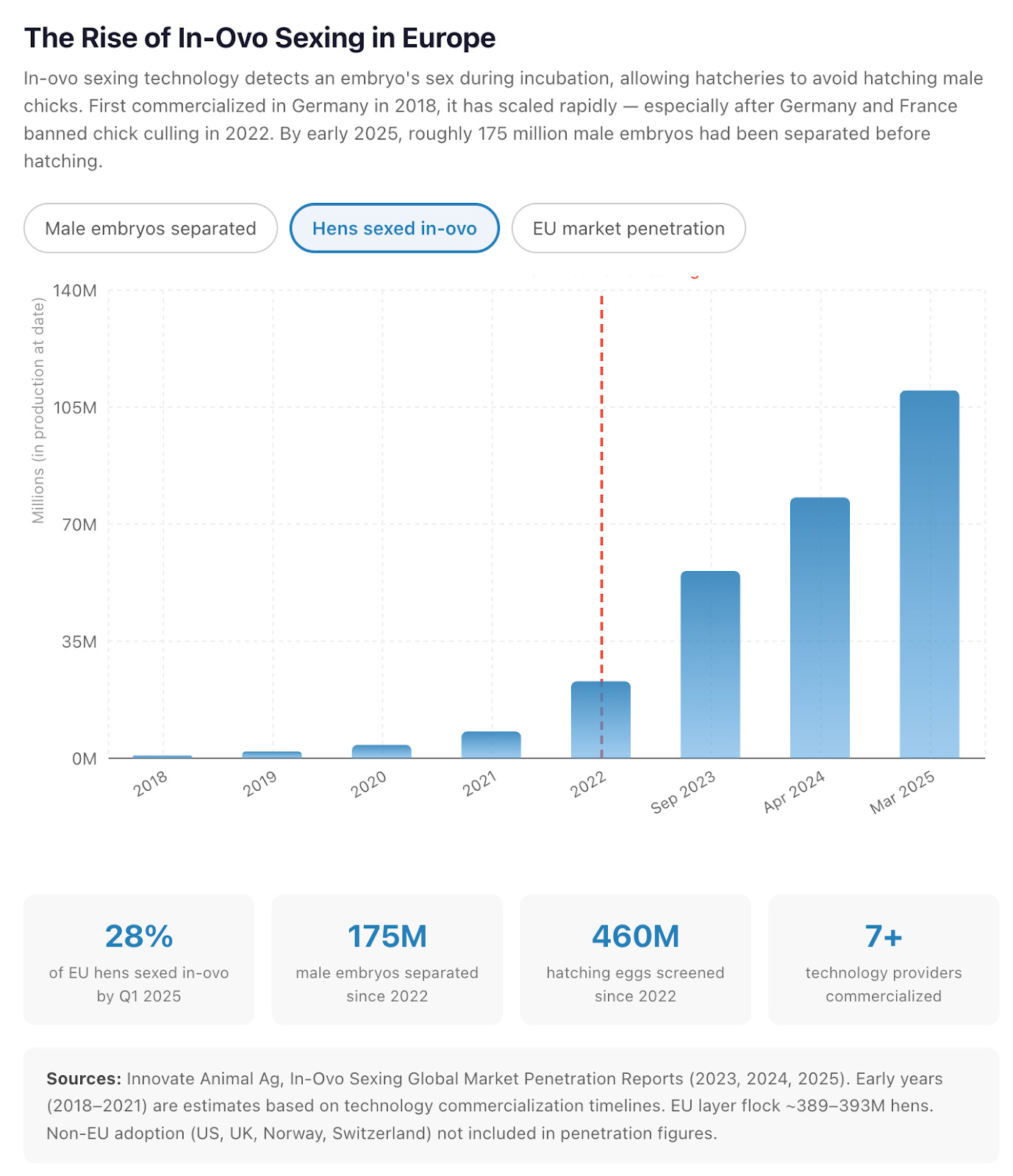
In-ovo sexing is the poster child of this approach. Decades of advocacy against killing male chicks had gained little traction because producers saw no viable alternative. Then innovators developed technologies that detect an embryo’s sex early in incubation, allowing hatcheries to avoid hatching male chicks altogether. Governments in France, Germany, the US, and Japan — along with philanthropies, including ours — funded work to bring down costs. That made it possible for half a dozen European countries to phase out chick killing, progress that has already spared over 175 million chicks from being born and killed.
Other humane technologies are ready to scale. Immunocastration can replace the castration of piglets. Sexed semen can prevent the birth of unwanted male dairy calves. Controlled atmospheric stunning can eliminate the shackling and hoisting of chickens at slaughter. Advocates and innovators are now scouting the next wave of such technologies — and AI could significantly accelerate their adoption.
Government subsidies can help too. The UK and Italy are subsidizing cage-free housing conversions, France is funding in-ovo sexing adoption, and Denmark is supporting alternatives to tail-cutting in pigs. But these are modest programs. What’s needed is investment at the scale of Germany’s promised (but still undelivered) €1.5 billion per year for higher welfare housing conversions.
The cruelty collective action problem is not some immovable feature of modern agriculture. It was created by technology, economics, and policy — and it can be unwound by them too. The tools are already in hand: regulations that extend to imports, targeted corporate campaigns, industry-wide agreements, humane technologies, and public subsidies.
The UK fast food chains that abandoned their welfare pledges last month did so because cruelty was still the profitable choice. Our job is to make sure that calculation doesn’t hold for much longer.
As always Lewis, thoughtful and powerful... bravo!
great piece. suppremely important, this coordination issue.
Could we ever install some equivalent of the Montreal Protocol, that regulated ozone-depleting substances worldwide?